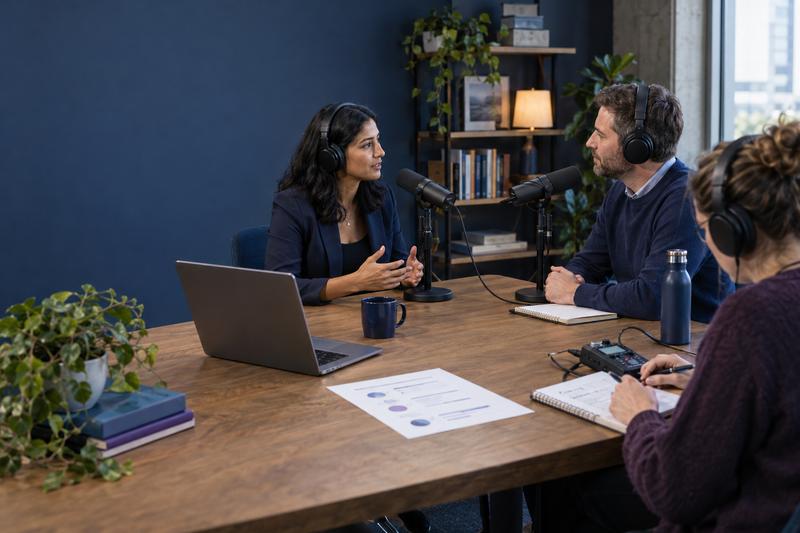

Influencer and expert-led content has a scaling problem. The work that makes it valuable—judgment, personal experience, audience trust and a distinctive point of view—is also the work most likely to disappear when a marketing team turns collaboration into a production line. AI can help, but only if it is used to structure the collaboration rather than flatten the contributor’s voice.
An AI creator brief is the operating layer between expert input and repeatable content production. It gives creators, subject-matter experts, editors and distribution teams a shared view of the audience, message, evidence, deliverables, approval path and measurement plan. Done well, it turns one strong expert conversation into a controlled system for articles, newsletters, social posts, webinars, sales enablement and paid tests without making every asset sound the same.
Start with contributor fit, not follower count
The first mistake in creator-led content is treating reach as the strategy. For B2B and high-consideration categories, the better question is whether the contributor has credibility with the exact audience you need to influence. A niche practitioner with a small but trusted audience may produce stronger demand signals than a broad creator with a large following and weak category authority. The brief should document why this person is credible, which audience segment they can help reach, and what specific belief or behavior the collaboration should change.
Before drafting the brief, score potential contributors across five dimensions: audience overlap, topic authority, original experience, communication style and commercial risk. Use AI to summarize public content, recurring themes and audience reactions, but keep final selection human-led. The goal is not to automate taste; it is to surface enough evidence for a better editorial decision.
Build the brief around one message
A useful creator brief is narrow. It should not ask the contributor to support every campaign theme, product narrative and channel goal at once. Choose one core message, one primary audience, one intended action and one proof angle. This aligns with the practical guidance in Content Marketing Institute’s B2B influencer marketing framework, which emphasizes credibility, relevance and strategic collaboration over generic amplification.
The brief should include a concise message architecture: the audience problem, the contrarian or useful point of view, the supporting evidence, the example the creator can uniquely provide, and the action the reader should take next. AI can help turn research, customer language and interview notes into draft angles, but the editor should decide which angle is sharp enough to publish.
Use AI to capture source material before drafting
The strongest creator content usually starts before the writing stage. Record a structured interview, collect prior posts, gather webinar transcripts, pull customer questions and ask the contributor for examples they have not shared publicly. Then use AI to cluster the material into claims, stories, objections, quotable ideas, tactical steps and open questions. This creates a source pack that protects the contributor’s perspective from being replaced by generic category language.
This is where brand infrastructure matters. If your AI system has access to approved terminology, evidence standards and editorial rules, it can help editors shape creator input without drifting off-brand. A practical companion is an AI-ready content style guide, which defines voice, claims, sourcing rules and review expectations before production begins.
Map deliverables to the funnel
Creator briefs become more valuable when they separate the expert idea from the final formats. One interview might become an awareness-focused LinkedIn post, a consideration-stage article, a webinar segment, a newsletter introduction, a sales follow-up asset and a short paid creative test. Each format needs a different job, not just a resized version of the same message. The brief should specify the funnel stage, channel, audience temperature, CTA and success signal for every deliverable.
TopRank Marketing’s B2B influencer marketing guide is useful here because it treats influencer collaboration as content planning, not just outreach. The same logic applies to AI-assisted workflows: the system should help translate expert input into channel-specific assets while preserving the underlying argument and the creator’s recognizable perspective.
Create a reusable creator brief template
A scalable template should be structured enough for consistency and flexible enough for originality. Include these fields:
- Campaign objective: awareness, subscriber growth, lead capture, pipeline influence, trust building or community activation.
- Audience segment: role, maturity, pain point, buying context and objections.
- Creator rationale: why this contributor is credible for this audience and topic.
- Core message: one sentence that states the belief the content should create or reinforce.
- Proof sources: interview notes, customer language, data, examples, case context and approved references.
- Voice boundaries: phrases to preserve, claims to avoid, disclosure requirements and brand tone rules.
- Deliverable map: formats, channels, owners, due dates and adaptation rules.
- Approval path: creator review, editorial review, legal or compliance review and final publishing owner.
- Measurement plan: engagement quality, referral traffic, subscriber conversion, influenced opportunities and reuse rate.
Govern the collaboration without slowing it down
Creator-led content carries trust risk. A contributor may make unsupported claims, overstate results, conflict with brand positioning or expect final approval over assets that need editorial independence. The brief should define decision rights before production starts: who owns factual accuracy, who approves quotes, who can change the angle, what must be disclosed, and when a piece is too risky to publish.
A simple risk tier helps. Low-risk collaborations might include expert commentary for an educational article. Medium-risk work might include co-branded webinars, benchmark commentary or sponsored creator posts. High-risk work might include regulated claims, customer data, comparative statements or conversion-heavy landing pages. The higher the risk, the more explicit the evidence and approval requirements should be.
Measure influence, not just impressions
The wrong dashboard will make creator programs look either wildly successful or impossible to justify. Impressions and likes are useful directional signals, but they rarely tell the whole story. Track whether creator-led assets attract the right audience, improve email capture, assist sales conversations, generate qualified referral traffic, earn backlinks, surface in AI search responses, or create reusable source material for future content.
For AI content teams, one of the most useful metrics is reuse efficiency: how many credible, on-brand assets can be created from one expert collaboration without requiring the creator to repeat the same work? Pair that with quality controls such as quote accuracy, claim approval, audience relevance and conversion-path performance. This turns the creator brief into both a production tool and a learning system.
The operating principle
AI should make creator collaboration more precise, not more generic. Use it to prepare better interviews, organize source material, generate format options, check consistency and accelerate adaptation. Keep humans responsible for contributor selection, editorial judgment, claim approval and the final point of view. That division of labor is what turns influencer expertise into a scalable content engine without sacrificing the trust that made the expertise valuable in the first place.